Determining Liability When Multiple Vehicles Are Involved in an Auto Accident
The moments following a highway collision are often chaotic, defined by twisted metal, shattered glass, and profound confusion. When a multi-car pileup occurs on busy Alabama interstates like I-65 or I-20, figuring out exactly who caused the chain reaction becomes an intricate puzzle. Injured victims are suddenly forced to manage severe physical trauma while facing aggressive insurance adjusters who immediately attempt to shift the blame to protect their bottom line. Because momentum transfers from one vehicle to the next, a single mistake by one driver can cause catastrophic damage to several surrounding motorists.
How Do Chain-reaction Accidents Typically Happen on Alabama Highways?
Chain-reaction accidents on Alabama highways often occur during heavy traffic, adverse weather conditions, or sudden stops. When one driver follows too closely or speeds, a single rear-end collision can force vehicles into one another, creating a multi-car pileup that requires complex liability investigations.
Interstate travel across Alabama frequently involves high speeds, commercial truck traffic, and sudden congestion. A chain-reaction crash usually begins when a single driver fails to adapt to these changing road conditions. For example, traffic slowing down near the I-65 interchanges in Birmingham or Montgomery demands immediate attention and adequate braking distance. If a trailing driver is distracted by a smartphone, traveling above the speed limit, or simply failing to look ahead, they may rear-end the vehicle in front of them with tremendous force.
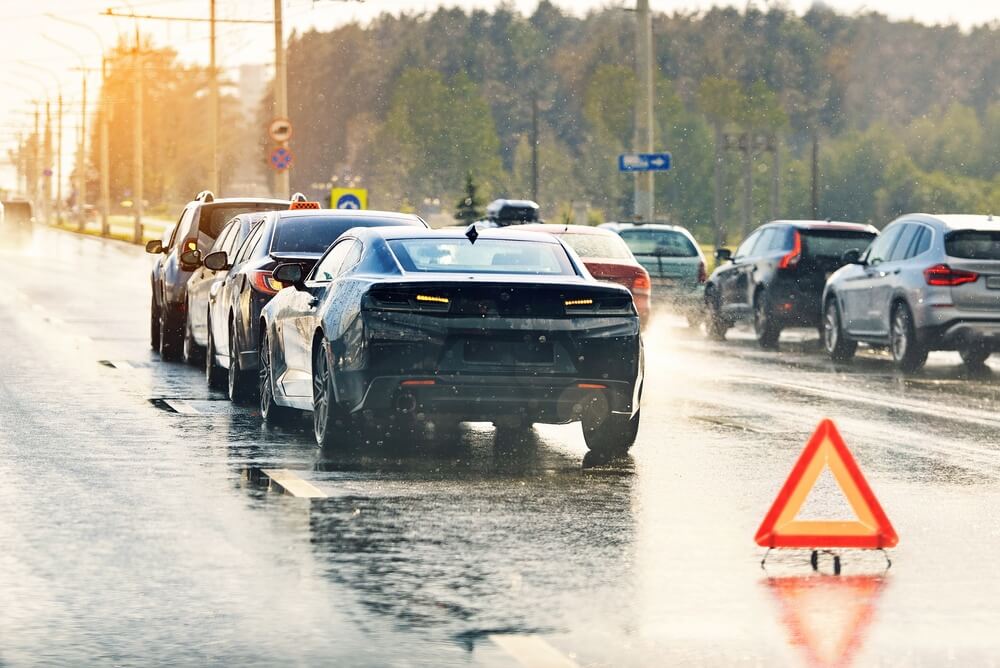
The physics of a high-speed collision means that the initial impact is rarely the end of the event. The force of the first strike often pushes the second vehicle forward into a third, and potentially a fourth. In other scenarios, an initial crash blocks the travel lanes, and approaching drivers who are traveling too fast for conditions are unable to stop in time, adding to the pileup. Adverse weather, such as sudden torrential downpours common in the Southeast, can reduce visibility and traction, making these chain-reaction events much more likely. Because the sequence of impacts happens in a matter of seconds, drivers involved often have wildly different accounts of who hit whom first.
Who is at Fault in a Multi-vehicle Accident in Alabama?
Fault in an Alabama multi-vehicle accident is determined by identifying which drivers breached their duty of care. Investigators analyze police reports, witness statements, and crash scene evidence to establish proximate cause, as more than one driver can share responsibility for the resulting damages.
Every motorist operating a vehicle owes a legal duty of care to everyone else on the road. This duty requires driving safely, obeying traffic laws, and maintaining a proper lookout for hazards. When a driver breaches this duty and causes harm, they are considered negligent. In a multi-vehicle accident, identifying the negligent party—or parties—is rarely straightforward. Often, more than one driver made a mistake that contributed to the final outcome.
For instance, the driver who started the chain reaction by rear-ending stopped traffic is clearly negligent. However, if the vehicle they hit was aggressively tailgating the car in front of it prior to the impact, that middle driver might also share a portion of the blame for the secondary collision. To untangle this web of liability, legal teams and crash investigators look at a specific set of factors:
- The exact resting positions of all vehicles involved.
- The length and trajectory of skid marks left on the pavement.
- Electronic control module data detailing speed and braking patterns.
- Cell phone records indicating potential digital distraction.
- The location and severity of property damage on each vehicle.
By systematically reviewing these elements, investigators build a timeline of the crash. This timeline establishes proximate cause, legally connecting a specific driver’s bad decisions to the injuries suffered by the victims.
How Does Alabama’s Pure Contributory Negligence Rule Affect Your Claim?
Alabama follows the strict pure contributory negligence rule. Under this standard, if an injured party is found to be even one percent at fault for the accident, they are completely barred from recovering any financial compensation from the other involved drivers.
Understanding pure contributory negligence is essential for anyone involved in an auto claim within the state. Alabama is one of only four states, along with the District of Columbia, that still enforce this remarkably harsh legal standard. In most of the country, if you are slightly at fault for a crash, your financial compensation is simply reduced by your percentage of blame. Here, the law operates as an all-or-nothing system. If a jury determines you were even one percent responsible for the circumstances leading to your injuries, you cannot recover a single dollar from a defendant who was ninety-nine percent at fault.
Insurance companies are highly aware of this rule and use it aggressively as a defense tactic. They will heavily scrutinize your actions leading up to the multi-car pileup. Did you brake too suddenly? Was one of your brake lights malfunctioning? Were you driving slightly over the speed limit when you were hit from behind? If an adjuster can find any reason to assign a fraction of the blame to you, they will attempt to deny your entire claim. This makes early and aggressive legal representation necessary to protect your rights and preserve evidence that proves your total lack of fault.
What is Joint and Several Liability Under Alabama Law?
Alabama recognizes joint and several liability, meaning an injured plaintiff who shares zero fault can seek full compensation from any single at-fault driver, regardless of that driver’s specific percentage of blame. The targeted driver cannot later seek contribution from other at-fault parties.
While the pure contributory negligence rule heavily favors insurance companies, the doctrine of joint and several liability provides a distinct advantage to innocent victims in multi-vehicle crashes. When a pileup occurs, there are often several negligent actors. One driver may have been speeding, while another made an illegal lane change that triggered the braking event. If you were a completely innocent victim caught in the crossfire, joint and several liability allows you to recover 100 percent of your total damages from any one of the negligent defendants.
This legal mechanism is incredibly beneficial when the at-fault drivers carry different levels of insurance coverage. If the driver who is eighty percent at fault only carries minimum liability limits that cannot cover your hospital bills, but the driver who is twenty percent at fault carries a large commercial policy, you can pursue the entire claim against the heavily insured party. Furthermore, Alabama does not allow for contribution among joint tortfeasors. This means the defendant who pays your settlement cannot turn around and sue the other at-fault drivers to get their money back.
How Do Investigators Determine Proximate Cause After a Crash?
Determining proximate cause requires law enforcement and legal teams to reconstruct the accident sequence. By examining vehicle damage, roadway evidence, and electronic data recorders, investigators identify the specific negligent actions that directly led to the injuries sustained in the pileup.
Establishing proximate cause means proving that your injuries were the direct, foreseeable result of another driver’s actions. In a chaotic scene involving four or five vehicles, connecting specific injuries to specific impacts requires meticulous work. The Alabama Law Enforcement Agency (ALEA) troopers or local police officers who respond to the scene take the first critical steps by documenting the immediate aftermath. However, law enforcement officers are primarily focused on clearing the highway and checking for criminal violations, such as driving under the influence.
To build a strong civil claim, independent accident reconstruction is often necessary. Professionals in this field use physics, engineering principles, and computer modeling to reverse-engineer the crash. They calculate the velocity of the vehicles upon impact, the angle of the collisions, and the forces exerted on the occupants. By mapping out the debris field and analyzing the crush damage on the front and rear bumpers of the involved cars, they can determine the exact order of impacts. This scientific approach removes the guesswork and provides a clear, factual basis for demonstrating exactly whose negligence caused your specific injuries.
What Evidence Proves Liability in a Multi-car Pileup?
Proving liability in a complex multi-car pileup relies on the official police report, dashcam footage, traffic camera recordings, and eyewitness testimony. Medical records from local facilities also help link the specific severity of your injuries to the mechanics of the crash. In any civil claim, the burden of proof rests entirely on the injured plaintiff. You must present compelling evidence that shows the other parties were negligent and that their negligence caused your damages. Because witness memories fade rapidly and the involved drivers often give contradictory statements, objective physical evidence is the foundation of a successful case.
Gathering this evidence must happen quickly before it is lost, destroyed, or recorded over. A thorough investigation into a multi-vehicle collision generally requires collecting and analyzing several specific types of documentation:
- Official crash reports from the responding police department or state troopers, which outline initial fault assessments and citations issued at the scene.
- Video surveillance footage from dashboard cameras, nearby commercial businesses, or Department of Transportation highway cameras.
- High-resolution photographs of the accident scene, capturing tire marks, weather conditions, and the final resting positions of the vehicles.
- Recorded statements from independent third-party witnesses who observed the crash but have no financial stake in the outcome.
- Comprehensive medical records and diagnostic imaging from treatment centers like UAB Hospital clearly document the traumatic injuries sustained.
Can a Driver Be Liable for Following Too Closely Under Alabama Law?
Yes, Alabama law explicitly prohibits following another vehicle more closely than is reasonable and prudent. If a driver rear-ends a vehicle because they failed to maintain a safe distance, they are typically found liable for the initial collision and subsequent chain-reaction impacts. Tailgating is one of the most common aggressive driving behaviors seen on our interstates, and it is a leading cause of chain-reaction crashes. State traffic statutes mandate that drivers leave sufficient space between their vehicle and the one ahead of them. When determining what constitutes a safe distance, drivers are legally required to account for their current speed, the density of the surrounding traffic, and the physical condition of the highway.
When a driver ignores this duty and follows too closely, they eliminate their ability to react safely to sudden emergencies. If traffic halts unexpectedly and a tailgating driver slams into the car ahead, the law generally presumes the rear driver is at fault for the initial impact. In a multi-vehicle scenario, this initial impact often pushes the struck car into the next vehicle, initiating the pileup. The driver who failed to maintain a reasonable following distance will likely bear liability for the cascading property damage and physical injuries that follow, provided no other driver intervened with their own negligent act.
What Happens if a Phantom Vehicle Caused the Pileup?
A phantom vehicle is one that causes a crash but leaves the scene without making physical contact. If a phantom driver forces someone to brake suddenly, leading to a pileup, injured victims must typically rely on their own uninsured motorist coverage for compensation.
A highly complex scenario arises when the vehicle that actually triggered the pileup never sustains a scratch and simply drives away. This is known as a phantom vehicle incident. For example, a driver might merge wildly across three lanes of traffic on I-20 without signaling, forcing the cars behind them to slam on their brakes and swerve, resulting in a massive multi-car collision. The reckless driver who caused the hazard continues down the road, completely unaware or uncaring of the devastation they left in their wake.
Because the pure contributory negligence standard is so strict, drivers who rear-end others will quickly point the finger at a phantom vehicle, claiming they had no choice but to brake. To validate a claim involving a phantom driver, independent corroboration is vital. Testimony from bystanders who saw the reckless merging vehicle, or dashcam footage capturing the erratic driving, is necessary to prove the hazard actually existed. If the phantom driver cannot be identified and located, injured victims must usually turn to the uninsured motorist (UM) provisions of their own auto insurance policies to seek financial recovery for their damages.
What Damages Can You Recover After a Chain-reaction Collision?
Victims of chain-reaction collisions who share no fault can recover compensatory damages. This includes economic damages like medical bills and lost wages, as well as non-economic damages for pain and suffering resulting from the trauma of the multi-vehicle accident. The financial impact of a serious auto accident can easily threaten a family’s stability. When you are severely injured due to the negligence of others, state law allows you to pursue compensatory damages designed to make you financially whole again. Calculating these damages requires looking at both the immediate out-of-pocket costs and the long-term impact the injuries will have on your quality of life.
Economic damages are tangible financial losses with clear dollar amounts. Non-economic damages compensate victims for the subjective, human cost of the trauma. An effective legal strategy demands thoroughly documenting every aspect of your losses to prevent insurance adjusters from lowballing the settlement value. In a successful claim, you may be able to recover compensation for:
- Past, current, and projected future medical expenses, including emergency room care, surgeries, physical therapy, and prescription medications.
- Lost wages for the time you were forced to miss work during your initial physical recovery.
- Loss of future earning capacity if your injuries leave you with a permanent disability that prevents you from returning to your previous profession.
- Physical pain, ongoing discomfort, and the emotional distress associated with surviving a violent multi-car collision.
- Property damage costs to repair your vehicle or compensate you for its fair market value if it was declared a total loss.
How Long Do You Have to File a Car Accident Claim in Alabama?
Under Alabama law, the statute of limitations for personal injury claims is generally two years from the date of the car accident. At Jones, Cobb, Wadsworth & Davis, LLC, our skilled attorneys are dedicated to standing up for the rights of accident victims across the region. We understand the complex legal standards governing multi-vehicle crashes and know how to build compelling cases that withstand insurance company scrutiny. Most personal injury attorneys work on a contingency fee basis, which means you don’t pay any attorney’s fees unless we win your case.
If you or a loved one has been injured in a highway pileup, contact our office today to schedule your free, confidential consultation. Let us focus on the legal fight so you can focus entirely on your physical recovery.
Frequently Asked Questions
Who pays my medical bills after a multi-car accident in Alabama?
Your health insurance or auto medical payments coverage typically pays your initial hospital bills. Once liability is proven, the at-fault driver’s insurance policies are responsible for compensating you for those medical expenses as part of your final settlement.
Do I have to speak to the other drivers’ insurance companies?
You are under no legal obligation to provide a recorded statement to the insurance carriers representing the other drivers. It is highly recommended that you allow your attorney to handle all communications with opposing insurance adjusters to protect your claim.
Can I still recover damages if the at-fault driver was uninsured?
Yes, if the primary at-fault driver lacks insurance, you can pursue compensation through the uninsured motorist coverage on your own auto policy. This coverage is designed specifically to protect you from drivers who fail to carry mandatory liability limits.
Will my case have to go to trial to determine liability?
Many multi-vehicle accident claims are successfully resolved through negotiated settlements outside of court. However, if the insurance companies refuse to offer fair compensation or dispute liability entirely, filing a lawsuit and presenting your case to a jury may be necessary.
How does the insurance company decide who started the chain reaction?
Insurance adjusters review the police report, vehicle damage photos, and witness statements to make their initial fault determination. However, their internal conclusions are often biased toward protecting their financial interests, which is why independent legal investigation is so important.
What if the police report places some of the blame on me?
A police report is the responding officer’s opinion and is not the final legal word on liability. Your legal team can challenge the officer’s findings by presenting contradictory evidence, accident reconstruction data, and witness testimony that proves you were not at fault.



Leave a Reply
Want to join the discussion?Feel free to contribute!